Tuesday, May 25, 2010

Colombia


Columbia, with its grand tropical forests, mountains, beaches, beautiful towns and charming people, must stand among the most attractive places in the world. Unfortunately, the continuing guerrilla war and the activities of cocaine cartels have made a significant part of Colombia, the media nicknamed "Locombia" (crazy country), not available to all, except for the foolhardy travelers. But there is a chance to enjoy the pungent mixture of legends and mysticism. If you avoid traveling on land transport, to attend only the major cities and tourist destinations, so stay tuned, you can greatly relax in Colombia and get a lot of pleasant emotions.

Activities in Colombia

Very popular six-day hiking in the wreck of La Siyudad Perdida (The Lost City). Conductors can provide transportation, meals and accommodation (conductor is necessary, because in this area is a lot of marijuana plants and coca). Five-or seven-day hike along the route Nabusimake Pico Colón through Sierra Nevada de Santa Marta - a great way to enjoy the mountains of Colombia. Excellent dive sites are located near the islands of Rosario 30 kilometers from Cartagena, and near the island of Baru, near the peninsula to the south of Cartagena on. The waters near the islands of San Andres and Providencia are populated by beautiful fish. Adventure tours in the jungle deep into the Amazon can be organized in Leticia. Equipped with well trained guides and are easily organize tours for up to 10 days. The jungle are often grim, so it is recommended to take with a photosensitive film, and a means of mosquitoes.


Tuesday, May 18, 2010

Titicaca Lake


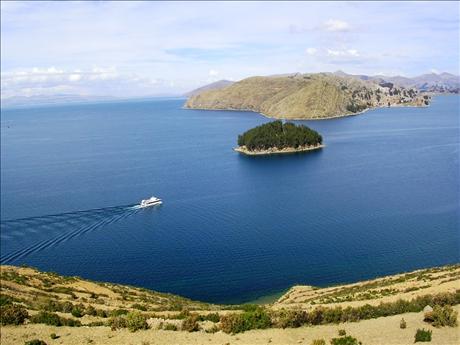
Titicaca Lake: on the border of Bolivia and Peru

Lost in the Andes and covered with legends, Titicaca awakens the imagination, makes one want to visit its shores. But the real attraction here is not visible - a few dozens of floating islands.


The lake itself had contrived to climb to an altitude of 3820 meters. Occupying the lower part of the highlands stakes Titicaca belongs to 2 countries - Peru and Bolivia. The maximum width of 80 kilometers, and the total surface - 8300 square kilometers, most of whom are located in Peruvian territory. Tourists traveling to Peru, familiarity with the lake beginning in Puno - a city founded in 1668 near the mine, where silver was mined. The town stands on a hillside on the slope increases, and he has nowhere else to grow. For three centuries, the population had accumulated to 100 thousand. There is speculation that the Titicaca - part of the ocean was cut off from him after the lifting of the Western Cordillera Oriental. This theory is confirmed by the presence on the Bolivian gigantic salt mines.

But most tourists are interested in the islands, which naturally float on the lake with all its population. It's hard to believe but it is true: Hundreds of people are born, grow up, spend their entire lives and leave them without leaving these islands, floating in the cool depths of nowhere over the lake.


"Lake Titicaca" in translation from the Aymara means "sacred stone". He was in the temple of the sun, and he in turn - on the island of the Sun, the largest of the entire lake archipelago. Unfortunately, from the temple itself remained only ruins. Tempered rather wayward Titicaca. Most steep it in the rainy season - from December to February. At this time, the river brings a lot of the red and the color of water in the lake is changing. In February, the level of the mirror is increased by half a meter, and maybe more. In the flood Titicaca overflows its banks, flooding fields and even the lower part of Puno, along with the pier. And when zaduyut winds up a big wave. Besides the lake there are ebbs and flows like the ocean, but water level fluctuations were modest - up to 80 centimeters. And yet, in such circumstances to live on the islands drifting, perhaps quieter than on the coast.


Tuesday, May 11, 2010

Chile Traditions


In Chile dominates the European blood, so here travelers from Western countries are not as distinguished as in Peru and Bolivia. For centuries, the Paris education of many Chilean intellectuals influenced the art, music, architecture.  This resulted in art galleries, museums, and theaters. Art, literature and music influence on world culture. Among the Chilean Nobel Prize  are poets Gabriela Mistral and Pablo Neruda. Until the military coup in 1973, Chile filmmakers were the boldest experimenters in Latin America. Folk music is particularly important for the victims of tyranny, and she often played a political emigrant abroad during the Pinochet regime.


Over 90% of the population is Catholic, but Evangelical Protestantism is becoming increasingly common. Catholic Architecture is impressive and ubiquitous, from grandiose colonial churches, holy places and finishing along the roads from which others are excellent examples of the fusion of various forms of folk arts. The official language in Chile - Spanish, but there are some folk languages. In the north of the country over 20 000 carriers Aymara, and in the south about half a million carriers of the Mapuche.

The most interesting linguistic minority - 2000 Media Rapa Nui, a Polynesian language of the inhabitants of Easter Island.

Chilean cuisine is diverse and includes seafood, beef, fresh fruits and vegetables. Among Chilean dishes listed as: empanadas (large tortillas with various fillings); humitas (corn volumes) and several types of bread prepared from flour or potatoes. The most satisfying dish - lomo a lo pobre («meat dish for the poor") is a huge piece of beef, put two fried eggs with potatoes, fried. Dish parillada confuse vegetarians and cardiologists, as its membership includes intestines, udders, as well as black pudding. One of the most delicious dishes - curanto - a hearty chowder with fish, shellfish, chicken, pork, lamb, beef and potatoes. Chilean wines - the best in South America. The popular drink pisco sour is a grape brandy with lemon, egg white and powdered sugar.


Thursday, May 6, 2010

Sao Paulo


This city is full of surprises, it may surprise anyone who comes here. Sao Paulo - is not only the largest city in South America, it is among the top three most visited cities in the world! There are several special characteristics that make Sao Paulo:

1. The city's architecture: the buildings in Sao Paulo are built in colonial-style mixed well with modern architecture. In Sao Paulo, many buildings, museums, churches built centuries ago, at the same time the architecture of this city can be called one of the most modern. In Sao Paulo, the ancient church can perfectly look on the background of a glass skyscraper.

2. Nightlife and Restaurants: In Sao Paulo 12500 and 15000 restaurants bars and nightclubs, these figures exceed the number of these establishments in Paris and in London, Sao Paulo - the richest night life! Of course, not to say that all clubs and restaurants are good, Sao Paulo - the city international, on this all the institutions are different. Differ and style, and quality.


3. Shopping: If you have arrived in Sao Paulo suggest you take a stroll to the shops. Shops in Sao Paulo a lot, can be found for all tastes and opportunities, but affects mainly the combination of quality and price, good quality and price, the ratio of our - low. April. And as in Sao Paulo can be advised to visit the Museum of Modern Art, stadium Pakaembu ", where he often played the" King of Football "Pele, snake Reserve Butantan" - the realm of reptiles. It is also interesting to visit the art museum, the State Art Gallery, Impiranya Museum, founded by Emperor Pedro I.

Friday, April 16, 2010

The Leaf House of Rio de Janeiro...


Located in Rio de Janeiro, Brazil, the Leaf House was inspired by Brazil’s Indian architecture, perfectly suited for the hot and humid climate of Angra dos Reis, which is just one hour south of Rio de Janeiro. The roof  in form of  big leaves protects all the enclosed spaces of the house from the sun - verandas and the in-between open spaces. All the open spaces are the main living areas, the essence of the design. They allow trade winds from the ocean to pass trough the building, providing natural ventilation and passive cooling. The architects see this as low-tech ecoefficiency where it has the greatest impact; as the concept of the architectural design.

There are no corridors, with the interior and exterior spaces being almost fused. Rainwater is taken from the roof for re-use. With its natural finishes, organic aesthetics and richness of details, the house is in harmony with the brazilian nature.


Friday, April 9, 2010

Capoeira - a fighting art


Capoeira - a fighting art that originated in the coastal areas of Brazil. A special alloy of African and European traditions allowed to include in this fighting art the elements of music, dance, magic rituals, acrobatics and games.

The game - that's exactly what Capoeira is, while maintaining the seriousness of the fighting arts. In a circle rivals are competing not in the number of strokes, they do not try to knock each other but try to outplay the opponent, showing a beautiful, elegant technique, using stealth and wit, delighting audiences with incredible possibilities of the human body. A goo win is  not enough for capoeirists. It must be beautiful, but the process of the game should be fun and exciting.

Friday, March 19, 2010

Holidays in


Venezuela is a country of exceptional travel opportunities. Here, eyes and soul, tortured by non-black soil landscapes will find something that helps to believe in the possibility of happiness on earth: clean sea, the sky clear, the mountains and the huge number of waterfalls, from the world's tallest to the smallest (almost bedside) fall at every step among indecent lush vegetation.

Venezuela has the rainy seasons. It lasts from May to October, in the rest there is the cloudless sky and a little lower, compared with the rainy period, temperature - an average of 25-30 degrees.

One of the most interesting places - the Orinoco Delta. Giant triangle consists of more than 50 major channels, covers an area roughly equal to Switzerland or the Netherlands.


In the delta grow Rhizophoraceae forest - huge trees, the trunks are entwined with vines and other plants that wish to get closer to the sunlight.

It is possible to travel with canoe alongside the tributaries and take the real Indian guide who will tell about the life of local tribes and will, among other things, how to extract very nutritious worms living in the trunks of palm trees (it is said that they are delicious with coconut milk).

Canaima National Park is located in the North, closer to the border with Brazil. The main attraction of these parts are the mountains with an Indian name "Tepui": steep cliffs over a kilometer in height with almost flat tops. This area is one of the most secluded and pristine natural areas of South America. Each flat top - the plateau is a unique biological island, kept unchanged since prehistoric times the whole ecological complex.

These mountains - the actual prototype of the "Lost World" of Conan Doyle. One of the most famous Tepui - is Mount Auyan with the world's highest waterfall called Angel. This place can not be named trampled, the waterfall was opened only in 1934.

If you wish to see the ocean and secluded islands, it is worth to visit another nature reserve in the archipelago of Los Roques, which is located 80 miles north of Caracas. This is one of the largest national parks in the Caribbean. You may reach it on a catamaran, and then a day sunbathing on the white sand beaches, typical of the Caribbean, scuba dive or observe the life of the local pelicans.

At the end of the journey it is not bad for a couple of days to fly to the island of Margarita and relax in an atmosphere of five star service. The island is a free economic zone, so the good shops and restaurants, casinos and other night spots are abundant here. In the evenings, salsa dancing and drinking the national Venezuelan daiquiri cocktail, invented personally by Hemingway - rum, gin, crushed ice and fresh juice. The writer himself preferred the lime juice.