Showing posts with label South America. Show all posts

Monday, December 2, 2013

The Best Things To Do In Sao Paulo

As the largest city in the country it is no surprise that a large proportion of visitors to Brazil arrive in Sao Paulo, and it is a great place to get a taste for Brazilian culture and also offers some wonderful attractions. Sao Paulo is the economic capital of Brazil, and is the country's wealthiest city with some remarkable areas including the skyscrapers of the downtown area where many large companies are located. Whether you are traveling to explore the culture and eat at great restaurants, to enjoy the activities in the area or are simply arriving in Sao Paulo before continuing on to the rest of the country, there are plenty of things to do in and around the city.


The first impression that many people will get is that Sao Paulo is just a large modern metropolis, but for those who take time to explore the city it actually has a wealth of historic buildings, and there are several areas that are well worth exploring. One of the most important and impressive sights in the city is the Catedral da Se, which is a fairly modern cathedral that was built in the first half of the twentieth century, and has two main towers rising over ninety meters, while the stunning interior is decorated to reflect Brazil and its culture. The Ibirapuera Park is one of the most important and popular green spaces in the city that has been beautifully maintained, while the Pico do Jaragua is a wonderful walk, and offers a spectacular view back over the city.

See The Brazilian Grand Prix


The Brazilian Grand Prix is traditionally the final race of the Formula One Season, and returned to the Interlagos Circuit just to the south of Sao Paulo in 1990, after a decade away. Brazil has had a long history of producing great racing drivers, and it was during the rise of local hero Ayrton Senna that the Sao Paulo authorities invested heavily in making the circuit the modern and exciting race circuit that visitors can see today. Today, visitors will see that Ferrari driver Felipe Massa is the local hero, and the stands are crammed with fans clad in the red colors of his team, which makes for a superb atmosphere in this exciting race.

Explore The City On A Bicycle


In the majority of cities the mere idea of riding a bicycle through the city center would be quite fearsome, but every Sunday and on public holidays the city opens up many miles of cycle lanes among some of the main sights of the city. Known as the Ciclofaixa de Lazer, this system offers visitors a great way to get an alternative perspective on the city, and will usually allow plenty of interaction with the locals who also like to ride between the major sights including the Ibirapuera Park and the Avenida Paulista. The route itself is designed for families and leisure riders, so most people will be taking a relaxed ride which helps to make it an enjoyable experience for visitors.

Climb The Banespa Tower


This skyscraper in central Sao Paulo was first built to be the headquarters of Banespa, the State Bank of Sao Paulo, and when building began in 1939 it took inspiration and many of its design features from Frank Lloyd Wright's Empire State Building. Standing at over 161 meters tall it was the tallest building in the city for over two decades, and is still one of the most prominent buildings.

Fortunately for visitors, they don't have to walk all the way to the top, as an elevator takes them up to within two flights of stairs of the viewpoint, which offers a spectacular panorama taking in sights like the Catedral da Se and the Martinelli Building, which was Sao Paulo's very first skyscraper.

Carnaval And The Gay Pride Parade


These are two of the largest and most impressive events in the Sao Paulo cultural calendar,  and visitors in the city during each event will find it to be a great spectacle with a wonderful atmosphere. The annual carnival takes place during the bank holiday at the end of February and the start of the March, and has a parade of wonderful floats with excellent samba dancers, and while it isn't as large as the Rio Carnaval, it is still a great event. Sao Paulo's Gay Pride parade is the largest such event in the world, taking place in either May or June on the Corpus Christi bank holiday, and also has a wonderful parade with a great party atmosphere with plenty of dance music and drink throughout the event.

Monday, April 8, 2013

Kokora Valley

Сoсora Valley in Colombia is part of a large national park Los Nevados. Here, a large number of wax palms grow tall. Wax palm tree itself is not something uncommon in South America. But here, it reaches a height of 60-80 meters.


Cocora valley is located in the heart of the Andes. Earlier, when there is no electricity, resin trees used by local farmers for making candles. From this, it seems, gave the name of "wax" palms.


As everywhere in the mountains, there are a lot of clouds and weather changes frequently. The clouds that cover like a blanket, the mountain peaks are quickly replaced by the sun. From these changes is particularly beautiful valley.


In the valley are found a large number of of hummingbirds. Them there are 5 different species.


Permeate the valley, mountain river and streams with small waterfalls.


Monday, June 11, 2012

The most mountainous capital of the world...

The most beautiful place in La Paz - Murillo is the area with beautifully restored buildings of the Parliament and the cathedral, wearing the same name as the city - Nuestra Senora de la Paz. Yes, the full name of La Paz it is in Latin America so much revered Mother of God, that many cities are named in her honor.


In the square ​​Murillo. The Parliament of Bolivia


The second central square in the city - square at the the Cathedral of San Francisco. From here just leaves Sagarnaga Street, where most souvenir shops.


The central street - Avenida Montes, turning into Perez Velasco


Central Street - Avenida  Perez Velasco.


Tuesday, February 9, 2010

Chile invites tourists...


Chile is preparing to take more and more tourists and promises its guests a multitude of different kinds of attractions. In this way, now it is developed the route "Chile Way", which will unite all the natural attractions of the country from north to south. The total length of the well-equipped route is 8500 kilometers. To overcome the selected areas will be possible on foot or by bicycle. In part, these roads have already been discovered in Patagonia and around Sanyago and fully route should be formed by 2015.

Still popular type of tourist attractions in Chile is whale watching. This is one of the best places in the world, here all year around you can see different kinds of whales. In the highlands tourists are offered a variety of winter classes - from alpine skiing to golf in the snow. There is a growing demand for wine, and on gastronomic tourism in the country. In addition, the coast of Chile is among the most popular cruises in South America.

It is worth noting that the race Paris - Dakar moved to South America until 2011. On the territory of Chile route will pass through the Atacama Desert and Patagonia. In addition to the direct participants in the race, the country expects to take a large number of spectators.

Global hotel chains are prepared to accommodate the growing number of tourists in Chile. A year ago there was opened Hotel & Spa Tierra Atacama - a small boutique hotel with the views of the volcano Licancabur. In March 2009, guests will take W Santiago -  the first luxurious hotel chain W in South America.


Tuesday, January 19, 2010

Buenos Aires...European Charm...


The Argentine's capital, is undoubtedly the busiest city in South America, life here does not stop even for a minute. On the street Avenida Corrientes there are cafes, kiosks, cinemas and shops that are working literally around the clock, even the buses in Buenos Aires travel at any time of day or night.

The capital of Argentina has a clear European charm, is subtly felt the spirit of Paris, Rome and Madrid, and this is not surprising, because the ancestors of most portenos, as they call themselves residents of Buenos Aires are from "Old World". Buenos Aires is home to almost 3 million people, but given the population of the suburbs - even more than 12 million.

In Buenos Aires, a huge number of attractions designed for every age and taste. Art lovers will find in this city of many different museums, galleries, theaters and monuments, and lovers of night life and vibrant cosmopolitan city offers the noisy clubs and discos, which boils fun in a non-stop. In Buenos Aires also has many cozy parks, where you can escape the bustle of the big city. This fun you can get from visiting museums, restaurants, beautiful monuments and, of course, tango shows.


The building is La Casa Rosada ( «Pink House"), bearing the official name of the Palacio de Gobierno (Government Palace), - the residence of the Government of Argentina. It is situated in the square Plaza de Mayo, have been the silent witness to the emotional and dramatic events in the history of Argentina.


In Buenos Aires there is a large number of parks, where peace and quiet reign. Park the 3rd of February, perhaps, the biggest of them, it starts in the neighborhood of Palermo and extends further to the northern border of the city. In the immediate vicinity of the Park On February 3, is a zoo and planetarium, as well as some of the most interesting places for recreation: Andalusian patio, Danish rose garden and a Japanese pavilion.

Plaza de la Republica (Republic Square)

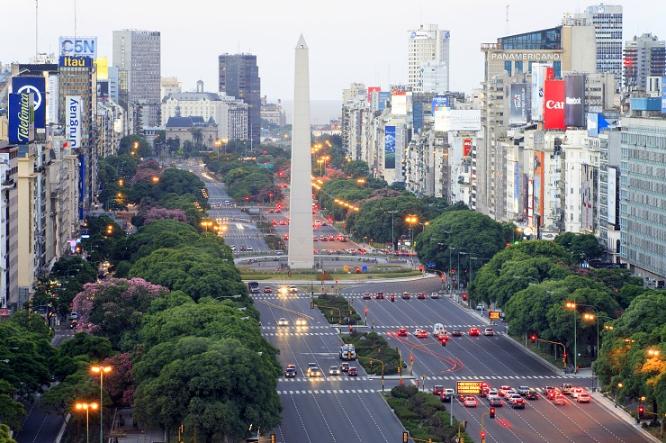
The most famous monument of Buenos Aires is, without doubt, a huge obelisk at the intersection of 9 de Julio and Corrientes avenidas, a symbol of the city. Erected it was in May 1936 to the 400-year anniversary of the founding of the city. The obelisk is installed in the center of the square Plaza de la Republica (Republic Square), at the place where the first time in Buenos Aires, the Argentine flag was posted. Its total height is 67 meters, himself obelisk occupies an area of 49 square meters. Not far from the obelisk located house-museum of the prominent Argentine science fiction writer Jorge Luis Borges. A well-known dance "Tango", has its origin in the outskirts of Buenos Aires, where he received widespread among poorer segments of the population. In 1910, the tango became popular in Paris and gradually spread throughout the world. December 11 is celebrated annually as the "Day of Tango". Buenos Aires is a city of colorful festivals, national holidays and sporting events. Number one in sport and the pride of all citizens, no doubt, is football. Squad has been one of the strongest in the world, Buenos Aires is ranked first in the world among all the cities on the total tonnage of football stadiums.


Buenos Aires was strong enough touched by the economic crisis that shook the whole country. People (in particular, and very young children) can be seen on the streets begging throughout the day and at night they go out into the streets and look in the trash something that somehow would help them survive. This should not cause you in disgust, before you the victim of a corrupt government. Yet one should be careful not to walk alone on dark streets. You can give alms to the poor, only better, if it would be something edible, rather than a trifle, which is immediately to spend money on alcohol. If you are looking for, where to have fun, Buenos Aires - the best place for such purposes: here an infinite number of discos, casinos, bars. Night in Buenos Aires never ends...

Tuesday, November 17, 2009

Argentina - The Connoisseur of Wine

The real word Argentina in reality means "land of silver", but you would be flabbergasted to be acquainted with the fact that Argentina is in reality famous for its wineries! This beautiful country is in fact known as the 5th largest wine producer in the world, and they have been doing this ever since the 16th century! If you are a big admirer of wine and you are looking forward to taste the sweet nectar, you will have about 1800 wineries that you can select from!

The foodstuff that you will discover in Argentina truly has a variety of impacts on you that you might never have assumed. The countries that have Argentinian influence are Italy, Spain, France as well as Germany! Ensure that you try some genuine chorizo, which is a hot meat based sausage, and it tastes scrumptious with eggs.

* Argentina is situated in South America and stands bordered by Paraguay and Bolivia in the north, Brazil and Uruguay in the northeast and Chile in the west and south.
* Argentina is the 8 largest country of the world, spreading over an area of approximately 2,766,890 sq km.
* Argentina comprises of the British controlled territories of the Falkland Islands, South Georgia, South Sandwich Islands and 969,464 sq km of Antarctica.
* The capital of Argentina is Buenos Aires and its official language is Spanish.
* The official religion of Argentina is Roman Catholic.
* As per the law, the President and Vice President of Argentina should be Roman Catholic.
* Argentina is a representative federal and democratic republic, with 23 provinces and the city of Buenos Aires as the Federal Capital.
* Iguazu Falls of Argentina are even higher than the Niagara Falls.
* Mt. Aconcagua of Argentina is the tallest mountain in the whole of South America.
* Moreno Glacier of Argentina is amongst the few glaciers in the world that are advancing.
* The popular dance form ‘Tango’ belongs to Argentina.
* Majority of the population in Argentina is of European origin.
* The cuisine of Argentina is largely influenced by that of Spain, Italy, Germany, France and other European countries.
* Current President, Cristina Fernández de Kirchner, was the first woman President to be elected in Argentina.
* Argentina is the 30th largest country in the world by population, with just over 40 million people.
* The official currency of Argentina is the peso.
* Argentina were one of the first countries to have radio broadcasting. The first broadcast was made on the 27th of August, 1920. Only twenty people had a receiver at the time!
* Average life expectancy in Argentina is 76 years.
* About 10% of people living in Argentina have private health cover.
* Argentina has a very good literacy rate- 97.6%. This ranks them at equal 58th in the world.
* The official language of Argentina is Spanish, although many people speak Italian and German. Some indigenous populations still speak their native languages.

*  Football (soccer) is the most popular sport in Argentina.
* A major export of Argentina is wine.
* Like animated films? The world’s first animated films were made and released in Argentina, by a man named uirino Cristiani in 1917.
* The Teatro Colón, located in Buenos Aires (the capital and largest city of Argentina), is one of the great opera houses in the world.
* Argentina loves movies! They have one of the highest rates of movie watching in the world. They enjoy watching both locally made movies and Hollywood movies.
* The Argentine government has estimated that 750,000 people living in Argentina are illegal immigrants.
* 20% of the population (according to the 2001 census) lack indoor running water and/or indoor plumbing.

Tuesday, October 27, 2009

South America Fun Facts

  • Colombia supplies 90% of the world production of Emeralds.

  • The Driest place on earth is the Atacama Desert, in Argentina. It's a place with virtually no vegetation; in some parts of Atacama Desert, it has never rained!

  • Highest peak of South America, Aconcagua, is also in Argentina. It is 22,834 feet high.

  • Venezuela is home to the highest uninterrupted waterfall, Salto Del Angel, at 979 meters.

  • Argentina. - largest Spanish-speaking country of South America

  • Sao Paulo, Brazil is the 2nd largest city in the world, with a population of almost 18 million!

  • Many of the most important discoveries of dinosaur fossils in the last 30 years were made in South America.

  • Brazil has many famous actresses, some of them are: Gloria Pires, Fernanda Montenegro, Florionda Bolkan, Sonia Braga, Regina Duarte, Vera Fischer, Xuxa, and Bruna Lombardi.

  • “Evita” a film by British director Alan William Parker was inspired in the life of Maria Eva Duarte de Peron, who was first lady of Argentina in the past century.

  • Gabriel Jose Garcia Marquez is one of the best writers in South America. He was born on March 6, 1928, in Aracataca, Magdalena,Colombia.Gabriel Garcia Marquez won the Nobel Prize for Literature in 1982.

  • UNESCO has declared Noel Kempff Mercado National Park (Bolivia), Rapa Nui National Park (Chile), Malpelo Fauna and Flora Sanctuary (Colombia), Galapagos Islands (Ecuador), Central Suriname Nature Reserve (Suriname) and Jesuit Missions of La Santisima Trinidad de Parana and Jesus de Tavarange (Paraguay) World Heritages Sites.

  • The Colombian people have two idols: Shakira (singer) and Carlos Vives (singer)…

  • Brazil takes up 47.8% of South America.

  • South America is unusual in that it is both highly urbanized and poor.

  • The Andes are a tall mountain range that lines the western portion of South America.

  • The Amazon River carries rain and snowfall from the Andes Mountains to the Atlantic Ocean.

  • In 1493, Pope Alexander VI drew a line that split South America between Spain and Portugal.

  • Simon Bolivar was a Venezuelan revolutionary leader known as "the Liberator." Bolivar fought the Spanish to win the independence of Venezuela, Colombia, Ecuador, Peru and Bolivia.Simon Bolivar.

  • Colombia is a mountainous nation known for it’s coffee and citrus exports. Unfortunately, the Colombian government has been unable to stop the flow of illegal drugs from their nation.

  • Oil is a major source of wealth in Venezuela.

  • Guyana, Suriname and French Guiana are small tropical nations along the north coast of South America.  Rainforest comprise a great deal of the sparsely populated lands of the nations.

  • Charles Darwin formed his theories about evolution Charles Darwinwhile sailing in the Galapagos Islands.

  • Bolivia is located high in the Andes mountains. American visitors to Bolivia often find it hard to breath due to the lack of oxygen at high altitude.

  • Paraguay is a poor, landlocked Andean nation.

  • Sao Paulo and Rio de Janeiro are the largest cities in Brazil, but the capital is the smaller city of Brasilia located deep in the highlands of central Brazil.

  • Carnival is a four-day Brazilian festival that comes before Lent.

  • Argentina has become a "melting pot" nation. More people have immigrated to Argentina from Europe than any other Latin American nation.

  • Tierra del Fuego is an archipelago (or a group of islands) at the southern tip of South America.

  • Copacabana has the most “best rate” possibilities. There are exchange businesses on every street, take a consensus and the best rate.