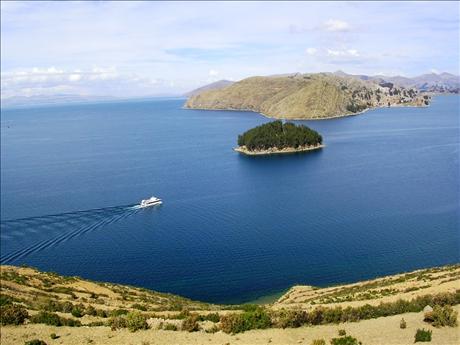
Titicaca Lake - a lake in the mountains of the Andes, located on the border between Peru and Bolivia, the Altiplano plateau. This is the largest lake in South America and the world's highest navigable lake.

25 rivers flow into the lake which are flowing down from the glaciers surrounding the Altiplano and follows the river Desaguadero. Water salinity is about 1 ‰, so Titicaca is a freshwater lake.
Titicaca Lake is the largest alpine lake in the world, it 'climbed' to a height of 3,812 meters. Alpine basin is formed as a result of ancient tectonic events, it is assumed that the lake was part of a larger body of water, sea or ocean.
There are different opinion on how to translate the name of the lake. "Titicaca Lake" is translated from the Aymara means "sacred stone". Another legend says that Lake Titicaca - is a "stone cougar", if you look at him with a bird's-eye view, you can see the outlines of this animal, surrounded by mountains. The second translation is "tin box". This justifies the name of a specific color of the water in the pond.
Tourists familiar with Lake Titicaca in Puno start - a city founded in 1668 near the mine, where silver was mined. Beside the lake, and tourists interested in the islands, which are naturally swim on the lake with all its population. A total of 32 natural lake of the island. 6 of them became a shelter for foreign tourists, they are called - "the island hotels". This Estebes, Amangani, Taquile, Soto - in the Peruvian part of the lake and Sun and Moon Islands are in the territory of Bolivia.
In addition to these "settled" Islands in the Bay of Puno there are also 44 floating islands - artificial one. They are collectively known as "Uros" - on behalf of their inhabitants - the Indians, numbering about 1200 people.


25 rivers flow into the lake which are flowing down from the glaciers surrounding the Altiplano and follows the river Desaguadero. Water salinity is about 1 ‰, so Titicaca is a freshwater lake.
Titicaca Lake is the largest alpine lake in the world, it 'climbed' to a height of 3,812 meters. Alpine basin is formed as a result of ancient tectonic events, it is assumed that the lake was part of a larger body of water, sea or ocean.
There are different opinion on how to translate the name of the lake. "Titicaca Lake" is translated from the Aymara means "sacred stone". Another legend says that Lake Titicaca - is a "stone cougar", if you look at him with a bird's-eye view, you can see the outlines of this animal, surrounded by mountains. The second translation is "tin box". This justifies the name of a specific color of the water in the pond.
Tourists familiar with Lake Titicaca in Puno start - a city founded in 1668 near the mine, where silver was mined. Beside the lake, and tourists interested in the islands, which are naturally swim on the lake with all its population. A total of 32 natural lake of the island. 6 of them became a shelter for foreign tourists, they are called - "the island hotels". This Estebes, Amangani, Taquile, Soto - in the Peruvian part of the lake and Sun and Moon Islands are in the territory of Bolivia.
In addition to these "settled" Islands in the Bay of Puno there are also 44 floating islands - artificial one. They are collectively known as "Uros" - on behalf of their inhabitants - the Indians, numbering about 1200 people.