Showing posts with label Argentina. Show all posts

Thursday, November 7, 2013

Mar del Plata

Mar del Plata, translated as "sea of the Plate region", is the 7th largest city in Argentina. 


With 30 miles of coastline, Mar del Plata has sections of beach that have their own personality just as neighborhoods in a city have distinct local flavor. Some beaches are geared more toward the college crowd (such as Bristol)and surfers (headed to Playa Varresse) while others are dedicated to a family friendly feel (such as La Perla beach). 

Downtown beaches including Bristol, Popular, Punta Iglesia,Las Toscas are centrally located and often very full. However, they have benefited from recent renovations and have the infrastructure to handle many thousands of sun worshipers. Get there early, or, cruise a bit further down the coast to see if you can find a spot at a less hectic beach. 

Mar del Plata beaches have been described as the most crowded in the world, often dotted completely with the multi-colored tops of beach umbrellas. The busiest, most wild, and expensive months for visiting are December, January, and February. Things slow down in March, when families and retired couples are drawn to a slower paces and slightly more affordable accommodations. While these are the busiest months, the city never closes down. There will always be a hotel or bed and breakfast option, catering to those who are interested in the cultural and recreational activities offered during the cooler months.

Mar del Plata offers much more than just sand and water. When the sun goes down there is a lively night scene including the area of Alem street and Irigoyen (known for its many pubs and nightclubs) and the coast and Constitution Avenue. Also, there are museums, zoos, casinos, shopping, and other recreational activities that draw people to the city. Here are a few of the attractions:

  • Casino Central de Mar del Plata
  • Juan Carlos Castagnino Municipal Museum of Art
  • Museo del Mar
  • De Los Padres Lake and Hills
  • Zoo El Paraíso
  • The Museum of Natural Science


Friday, October 25, 2013

Cuisine of Argentina and Chile

Argentine cuisine is influenced by waves of European immigration, particularly from Italy. You'll find many Italian restaurants and pizzerias, plus heladerias, or ice-cream parlors, serving Italian cuisine and gelatos . Argentina is known for its beef, and many meals are based on substantial amounts of carne, but other foods are certainly available. Lingering after an evening meal with a sobremesa is a customary time for conversation.

Soft drinks and fruit juices are popular. As elsewhere, ask for jugo puro, or jugo exprimido, for fresh squeezed. Licuados, milky fruit shakes, are popular. Do try maté tea at least once. Other tea is served black with lemon. Ask for té con leche if you want milk in your tea. Hot chocolate is served at breakfast. Coffee is usually an espresso.

  • café chico: small cup of strong, black coffee
  • café cortado: small coffee with a little milk, often in a glass
  • café con leche: coffee with lots of milk, usually served only at breakfast
Local beers and wine are excellent. Many Argentines mix a bit of mineral water in their wines to make a spritzer. Try these Recipes from Argentina. When you're in Argentina, be sure to try:
  • Asado: various cuts of meat cooked over coals and usually served with chimichurri marinade, french fries and salad; also called a parillada
  • Carbonada: beef stew with rice, potatoes, sweet potatoes, corn, squash, apples and pears
  • Puchero: beef, chicken, bacon, sausage, corn, peppers, tomatoes, onions, cabbage, sweet potatoes, squash casserole; may have beans
  • Sopa a la criolla: roasted suckling pig
  • Ñoquis: gnocchi or potato dumplings served with marinara or other tomato sauce
  • Arroz con pollo: chicken and rice casserole with eggs and vegetables
  • Puchero de gallina: chicken, sausage, corn, potato and squash
  • Locro: corn, white beans, beef, sausage, squash in a stew
  • Empanada de humita: pasty filled with corn, onion, cheese and flour
Chile

Chilean cuisine tends to the international, plus wonderful seafood that forms the base of many favored dishes. Ethnic restaurants abound in the cities. Vegetarian meals are available.
Soft drinks and juices are everywhere. The licuados, fruity milk shakes, are good. Try moté con huesillo , a peach and barley drink. Coffee is usually instant, but espresso is becoming popular. Tea is served black with lemon. Herbal teas, aguitas, are popular after dinner drinks. Try manzanilla, camomile, or a boldo .

Chilean wines are superb. Beer, pisco, aguardiente and imported hard liquors are popular. Make sure you try a Pisco Sour, made with egg white, lemon juice and powdered sugar. Try these Recipes from Chile. And when you're in Chile, be sure to try:
  • Cazuela: soup with meat or chicken, potato, corn and squash or other vegetables
  • Pastel de choclo: corn pie with meat, vegetables, chicken, olives and hard-boiled eggs
  • Lomo a lo pobre: fried beef, eggs, onions and french fries
  • Arroz con pollo: chicken and rice casserole
  • Curanto: seafood stew with chicken, pork, lamb, beef and potato
  • Chupes: stews of fish or beef

Thursday, May 31, 2012

Mar-del-Plata


Mar del Plata - a beach resort on the Atlantic coast of Argentina. This is a very charming green city with lots of luxury villas and a popular holiday destination Argentines. It is also one of the most important fishing ports of the country. The holiday season lasts from December to February. In Mar del Plata is interesting to walk along the harbor, visit the Marine Park Aquarium, where you can watch an exciting show with sea lions, dolphins and sharks, water park - Akvasol with water rides and a mini-zoo with various animals. You can also see the acrobatic performances of athletes in the water-skiing and much more.

Among the most common entertainment - mountain biking, the conquest of picturesque rocks piled up in the Sierra de los Padres (270 meters above sea level), wind-surfing: the waves off the coast of Mar del Plata, sometimes reaching 3 meters in height - and golf . The resort has four golf club and five golf courses of international level overlooking the green expanse of the Argentine plains or the sea.


Another popular Argentine beach resort - Miramar. It is located in the temperate zone, so there is not too hot. In January daytime temperature is 25 degrees Celsius, and water temperature does not exceed 22 degrees. It is located 137 km south of Mar del Plata. It is popular mainly among the local residents, because there is no such a fuss, in a crowded recreation areas. At Miramar offers travelers the full range of amenities, and simple relaxation on sandy beaches and boating and fishing, surfing, golf. Here you will find a lively nightlife and countless restaurants.


Tuesday, June 15, 2010

Perito Moreno Glacier


Perito Moreno - is a huge block of ice, Kotra constantly cracking and crunching. Around him organized park, with paths for long walks (in October 2008, most of the tracks have been built). This is the main attraction of the park. The glacier is located near the tiny tourist town of El Calafate (EC - a local berry). Very pretty town, a few wooden buildings create a very cozy atmosphere. Locals say that the winter here is very hard - withering icy wind. While the image of penguins surrounding tourist, as in Cuba - Che Guevara, to the penguins still fly and fly.

its age is about 30000 years. The most delightful of the Perito Moreno glacier is named in honor of the 19 th century explorer, who discovered him. Under the weight of snow in the ice grains is not air, so that the glacier is transparent blue.
This icy river, Perito Moreno Glacier, can every day to move up to 450 meters per year.  The movement of the glacier Perito Moreno, every few years, blocking the natural flow path Rica in the lake Lago Argentino. On the one hand, the accumulating mass of water increase the normal water level by 20-35 meters. Ultimately, however, water pressure crushes the ice and when the water breaks, Perito Moreno is a stunner. The spectacle may last from several hours to several days.

At this time, tranquil lake turns into a stormy sea. "Huge chunks of ice larger than the 15-store buildings are breaking away from the glacier wall and with a deafening roar severed in the water", - said in televised documentary film "La kuerra del yelo". The unusual phenomenon of nature to cause a huge influx of tourists in the National Park of Argentina, Los Glaciares National Park. Tens of thousands of tourists watch the impressive spectacle of the collapse of the glacier Perito Moreno. 'Everyone admires, seeing this wonderful phenomenon of the natural disaster. This miracle of nature declared UNESCO world heritage of mankind.

Tuesday, January 19, 2010

Argentinian Tango...The Passion Dance...


Argentinian Tango was born in the late XIX - early XX centuries 2 banks of the Rio de La-Plata, which separates Argentina and Uruguay. Most of his dancing in the port area sailors. Then tango passed to the brothels of Argentina. While waiting for their turn (at the time in Argentina to 10 men with one woman), men were taught each other in various pa in Argentine tango. Later, the tango had migrated to Paris and found himself in wealthy homes, restaurants, fashion. In the 70 years of XX century, thanks to Gustavo Naveira, was born a new style of tango - tango-nuevo (new), which is mainly performed under complicated music Piazzolla.


Buenos Aires...European Charm...


The Argentine's capital, is undoubtedly the busiest city in South America, life here does not stop even for a minute. On the street Avenida Corrientes there are cafes, kiosks, cinemas and shops that are working literally around the clock, even the buses in Buenos Aires travel at any time of day or night.

The capital of Argentina has a clear European charm, is subtly felt the spirit of Paris, Rome and Madrid, and this is not surprising, because the ancestors of most portenos, as they call themselves residents of Buenos Aires are from "Old World". Buenos Aires is home to almost 3 million people, but given the population of the suburbs - even more than 12 million.

In Buenos Aires, a huge number of attractions designed for every age and taste. Art lovers will find in this city of many different museums, galleries, theaters and monuments, and lovers of night life and vibrant cosmopolitan city offers the noisy clubs and discos, which boils fun in a non-stop. In Buenos Aires also has many cozy parks, where you can escape the bustle of the big city. This fun you can get from visiting museums, restaurants, beautiful monuments and, of course, tango shows.


The building is La Casa Rosada ( «Pink House"), bearing the official name of the Palacio de Gobierno (Government Palace), - the residence of the Government of Argentina. It is situated in the square Plaza de Mayo, have been the silent witness to the emotional and dramatic events in the history of Argentina.


In Buenos Aires there is a large number of parks, where peace and quiet reign. Park the 3rd of February, perhaps, the biggest of them, it starts in the neighborhood of Palermo and extends further to the northern border of the city. In the immediate vicinity of the Park On February 3, is a zoo and planetarium, as well as some of the most interesting places for recreation: Andalusian patio, Danish rose garden and a Japanese pavilion.

Plaza de la Republica (Republic Square)

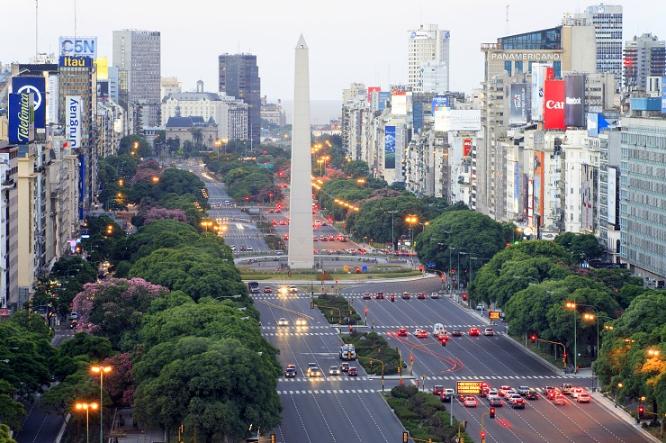
The most famous monument of Buenos Aires is, without doubt, a huge obelisk at the intersection of 9 de Julio and Corrientes avenidas, a symbol of the city. Erected it was in May 1936 to the 400-year anniversary of the founding of the city. The obelisk is installed in the center of the square Plaza de la Republica (Republic Square), at the place where the first time in Buenos Aires, the Argentine flag was posted. Its total height is 67 meters, himself obelisk occupies an area of 49 square meters. Not far from the obelisk located house-museum of the prominent Argentine science fiction writer Jorge Luis Borges. A well-known dance "Tango", has its origin in the outskirts of Buenos Aires, where he received widespread among poorer segments of the population. In 1910, the tango became popular in Paris and gradually spread throughout the world. December 11 is celebrated annually as the "Day of Tango". Buenos Aires is a city of colorful festivals, national holidays and sporting events. Number one in sport and the pride of all citizens, no doubt, is football. Squad has been one of the strongest in the world, Buenos Aires is ranked first in the world among all the cities on the total tonnage of football stadiums.


Buenos Aires was strong enough touched by the economic crisis that shook the whole country. People (in particular, and very young children) can be seen on the streets begging throughout the day and at night they go out into the streets and look in the trash something that somehow would help them survive. This should not cause you in disgust, before you the victim of a corrupt government. Yet one should be careful not to walk alone on dark streets. You can give alms to the poor, only better, if it would be something edible, rather than a trifle, which is immediately to spend money on alcohol. If you are looking for, where to have fun, Buenos Aires - the best place for such purposes: here an infinite number of discos, casinos, bars. Night in Buenos Aires never ends...

Tuesday, December 15, 2009

The Falkland Islands

The Falkland Islands/Islas Malvinas are a popular addition to many Antarctic voyages – usually in conjunction with a visit to South Georgia – but they’re well worth seeing on their own for their spectacular populations of penguins, seals and albatrosses. Surrounded by the South Atlantic and by centuries of controversy, the islands lie 490km east of Patagonia. 2 main islands, East and West Falkland, and more than 700 smaller ones cover 12, 173 sq km, about the same area as Northern Ireland or Connecticut.

Today more than four-fifths of the 3140 Falklanders (sometimes called ‘Kelpers’) live in Stanley. There are also more than 1200 British military personnel, nearly all at the Mt Pleasant base. The rest of the islanders live in ‘Camp, ’ the name given to all of the Falklands outside Stanley. Few of the numerous smaller offshore islands are inhabited. About 60% of Falklanders are native born, some tracing their ancestry back 6 or more generations. Most of the remainder are immigrants or temporary residents from the UK.


The Falklands retain their rural character: the islands are laced with 400km of roads, but there’s not one traffic light.

The Falkland Islands are home to a plethora of marine life, from 5 different species of penguins to whales and sea birds that hover around Stanley Harbour.

The lifestyle in the Falkland Islands resembles that of a small English or Scottish village/town and communities on the Falkland Islands are highly self-contained. The influx of the British Forces has obviously had an effect on the Islands. More people now visit for a variety of reasons. The islanders themselves have benefited from the additional amenities offered by the Forces. The population is very keen to remain under British sovereignty.

Tuesday, November 24, 2009

Buenos Aires is the biggest and the most populated metropolitan city


Buenos Aires is the biggest and the most populated metropolitan city in the country with a population of more than 13 million people. It is the capital of Argentina and is considered to be the financial, commercial, industrial, cultural and political capital of the country. It is located on the eastern shore of the Río de la Plata, on the southeastern coast of the South American continent.

The city derived its name from Nostra Signora di Bonaria, a sanctuary located in the Cagliari, Sardinia. In Spanish, this name means fair winds.

Inhabitants of the city are known as Portenos. A majority of population residing in the city has its origins in Spain and Italy. Apart from these, there are also people originating from other European nations including Germany, Portugal, Poland, Ireland, France, Croatia, England and Wales. Other major communities living in the city include Jewish immigrants, Arabs, Armenians, Japanese, Chinese and Koreans. 90 % of the inhabitants are Roman Catholics. Spanish is the official language in this city.
The capital of Argentina is an interesting tourist destination offering several cultural attractions and an ample glimpse of urban cosmopolitan life in Argentia. The biggest attraction in this city is the Teatro Colon, one of the world's greatest opera houses. Other notable features in the city include the University of Buenos Aires, City Hall, building of the Argentine National Congress and several museums.
Although immigrants populated the City for many decades, Buenos Aires developed its own identity reflected in icons such as the Tango and its slang, 'lunfardo'. More than 3 million people each day witness the relentless pace of a City that never sleeps.

While in Buenos Aires visitors will find themselves bombarded with choices on what to do. An obvious selection is spending time on Tango related activities, such as shows and night classes or sneaking into the many bars where thousands of locals of all ages practice the dance regularly. But there are many more things visitors can enjoy doing, from exploring a miriad of museums and theaters to spending time discovering some of the great local food, including the world reknown argentine beef. City tours and walks through parks and neighborhoods are mandatory to acquire a taste of Buenos Aires.


Tuesday, November 17, 2009

Argentina - The Connoisseur of Wine

The real word Argentina in reality means "land of silver", but you would be flabbergasted to be acquainted with the fact that Argentina is in reality famous for its wineries! This beautiful country is in fact known as the 5th largest wine producer in the world, and they have been doing this ever since the 16th century! If you are a big admirer of wine and you are looking forward to taste the sweet nectar, you will have about 1800 wineries that you can select from!

The foodstuff that you will discover in Argentina truly has a variety of impacts on you that you might never have assumed. The countries that have Argentinian influence are Italy, Spain, France as well as Germany! Ensure that you try some genuine chorizo, which is a hot meat based sausage, and it tastes scrumptious with eggs.

* Argentina is situated in South America and stands bordered by Paraguay and Bolivia in the north, Brazil and Uruguay in the northeast and Chile in the west and south.
* Argentina is the 8 largest country of the world, spreading over an area of approximately 2,766,890 sq km.
* Argentina comprises of the British controlled territories of the Falkland Islands, South Georgia, South Sandwich Islands and 969,464 sq km of Antarctica.
* The capital of Argentina is Buenos Aires and its official language is Spanish.
* The official religion of Argentina is Roman Catholic.
* As per the law, the President and Vice President of Argentina should be Roman Catholic.
* Argentina is a representative federal and democratic republic, with 23 provinces and the city of Buenos Aires as the Federal Capital.
* Iguazu Falls of Argentina are even higher than the Niagara Falls.
* Mt. Aconcagua of Argentina is the tallest mountain in the whole of South America.
* Moreno Glacier of Argentina is amongst the few glaciers in the world that are advancing.
* The popular dance form ‘Tango’ belongs to Argentina.
* Majority of the population in Argentina is of European origin.
* The cuisine of Argentina is largely influenced by that of Spain, Italy, Germany, France and other European countries.
* Current President, Cristina Fernández de Kirchner, was the first woman President to be elected in Argentina.
* Argentina is the 30th largest country in the world by population, with just over 40 million people.
* The official currency of Argentina is the peso.
* Argentina were one of the first countries to have radio broadcasting. The first broadcast was made on the 27th of August, 1920. Only twenty people had a receiver at the time!
* Average life expectancy in Argentina is 76 years.
* About 10% of people living in Argentina have private health cover.
* Argentina has a very good literacy rate- 97.6%. This ranks them at equal 58th in the world.
* The official language of Argentina is Spanish, although many people speak Italian and German. Some indigenous populations still speak their native languages.

*  Football (soccer) is the most popular sport in Argentina.
* A major export of Argentina is wine.
* Like animated films? The world’s first animated films were made and released in Argentina, by a man named uirino Cristiani in 1917.
* The Teatro Colón, located in Buenos Aires (the capital and largest city of Argentina), is one of the great opera houses in the world.
* Argentina loves movies! They have one of the highest rates of movie watching in the world. They enjoy watching both locally made movies and Hollywood movies.
* The Argentine government has estimated that 750,000 people living in Argentina are illegal immigrants.
* 20% of the population (according to the 2001 census) lack indoor running water and/or indoor plumbing.

Tuesday, October 27, 2009

South America Fun Facts

  • Colombia supplies 90% of the world production of Emeralds.

  • The Driest place on earth is the Atacama Desert, in Argentina. It's a place with virtually no vegetation; in some parts of Atacama Desert, it has never rained!

  • Highest peak of South America, Aconcagua, is also in Argentina. It is 22,834 feet high.

  • Venezuela is home to the highest uninterrupted waterfall, Salto Del Angel, at 979 meters.

  • Argentina. - largest Spanish-speaking country of South America

  • Sao Paulo, Brazil is the 2nd largest city in the world, with a population of almost 18 million!

  • Many of the most important discoveries of dinosaur fossils in the last 30 years were made in South America.

  • Brazil has many famous actresses, some of them are: Gloria Pires, Fernanda Montenegro, Florionda Bolkan, Sonia Braga, Regina Duarte, Vera Fischer, Xuxa, and Bruna Lombardi.

  • “Evita” a film by British director Alan William Parker was inspired in the life of Maria Eva Duarte de Peron, who was first lady of Argentina in the past century.

  • Gabriel Jose Garcia Marquez is one of the best writers in South America. He was born on March 6, 1928, in Aracataca, Magdalena,Colombia.Gabriel Garcia Marquez won the Nobel Prize for Literature in 1982.

  • UNESCO has declared Noel Kempff Mercado National Park (Bolivia), Rapa Nui National Park (Chile), Malpelo Fauna and Flora Sanctuary (Colombia), Galapagos Islands (Ecuador), Central Suriname Nature Reserve (Suriname) and Jesuit Missions of La Santisima Trinidad de Parana and Jesus de Tavarange (Paraguay) World Heritages Sites.

  • The Colombian people have two idols: Shakira (singer) and Carlos Vives (singer)…

  • Brazil takes up 47.8% of South America.

  • South America is unusual in that it is both highly urbanized and poor.

  • The Andes are a tall mountain range that lines the western portion of South America.

  • The Amazon River carries rain and snowfall from the Andes Mountains to the Atlantic Ocean.

  • In 1493, Pope Alexander VI drew a line that split South America between Spain and Portugal.

  • Simon Bolivar was a Venezuelan revolutionary leader known as "the Liberator." Bolivar fought the Spanish to win the independence of Venezuela, Colombia, Ecuador, Peru and Bolivia.Simon Bolivar.

  • Colombia is a mountainous nation known for it’s coffee and citrus exports. Unfortunately, the Colombian government has been unable to stop the flow of illegal drugs from their nation.

  • Oil is a major source of wealth in Venezuela.

  • Guyana, Suriname and French Guiana are small tropical nations along the north coast of South America.  Rainforest comprise a great deal of the sparsely populated lands of the nations.

  • Charles Darwin formed his theories about evolution Charles Darwinwhile sailing in the Galapagos Islands.

  • Bolivia is located high in the Andes mountains. American visitors to Bolivia often find it hard to breath due to the lack of oxygen at high altitude.

  • Paraguay is a poor, landlocked Andean nation.

  • Sao Paulo and Rio de Janeiro are the largest cities in Brazil, but the capital is the smaller city of Brasilia located deep in the highlands of central Brazil.

  • Carnival is a four-day Brazilian festival that comes before Lent.

  • Argentina has become a "melting pot" nation. More people have immigrated to Argentina from Europe than any other Latin American nation.

  • Tierra del Fuego is an archipelago (or a group of islands) at the southern tip of South America.

  • Copacabana has the most “best rate” possibilities. There are exchange businesses on every street, take a consensus and the best rate.