Showing posts with label Buenos Aires. Show all posts

Tuesday, January 19, 2010

Buenos Aires...European Charm...


The Argentine's capital, is undoubtedly the busiest city in South America, life here does not stop even for a minute. On the street Avenida Corrientes there are cafes, kiosks, cinemas and shops that are working literally around the clock, even the buses in Buenos Aires travel at any time of day or night.

The capital of Argentina has a clear European charm, is subtly felt the spirit of Paris, Rome and Madrid, and this is not surprising, because the ancestors of most portenos, as they call themselves residents of Buenos Aires are from "Old World". Buenos Aires is home to almost 3 million people, but given the population of the suburbs - even more than 12 million.

In Buenos Aires, a huge number of attractions designed for every age and taste. Art lovers will find in this city of many different museums, galleries, theaters and monuments, and lovers of night life and vibrant cosmopolitan city offers the noisy clubs and discos, which boils fun in a non-stop. In Buenos Aires also has many cozy parks, where you can escape the bustle of the big city. This fun you can get from visiting museums, restaurants, beautiful monuments and, of course, tango shows.


The building is La Casa Rosada ( «Pink House"), bearing the official name of the Palacio de Gobierno (Government Palace), - the residence of the Government of Argentina. It is situated in the square Plaza de Mayo, have been the silent witness to the emotional and dramatic events in the history of Argentina.


In Buenos Aires there is a large number of parks, where peace and quiet reign. Park the 3rd of February, perhaps, the biggest of them, it starts in the neighborhood of Palermo and extends further to the northern border of the city. In the immediate vicinity of the Park On February 3, is a zoo and planetarium, as well as some of the most interesting places for recreation: Andalusian patio, Danish rose garden and a Japanese pavilion.

Plaza de la Republica (Republic Square)

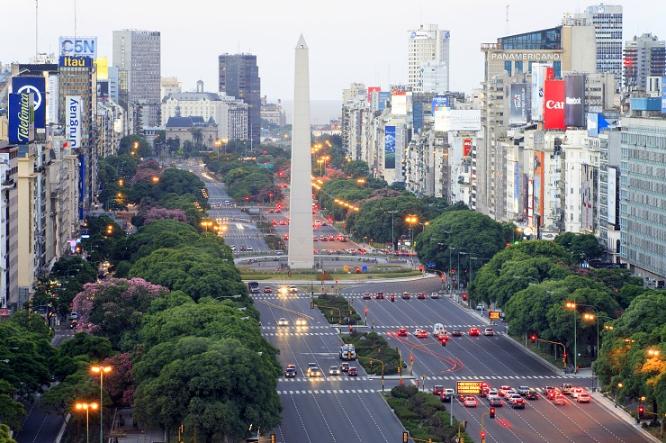
The most famous monument of Buenos Aires is, without doubt, a huge obelisk at the intersection of 9 de Julio and Corrientes avenidas, a symbol of the city. Erected it was in May 1936 to the 400-year anniversary of the founding of the city. The obelisk is installed in the center of the square Plaza de la Republica (Republic Square), at the place where the first time in Buenos Aires, the Argentine flag was posted. Its total height is 67 meters, himself obelisk occupies an area of 49 square meters. Not far from the obelisk located house-museum of the prominent Argentine science fiction writer Jorge Luis Borges. A well-known dance "Tango", has its origin in the outskirts of Buenos Aires, where he received widespread among poorer segments of the population. In 1910, the tango became popular in Paris and gradually spread throughout the world. December 11 is celebrated annually as the "Day of Tango". Buenos Aires is a city of colorful festivals, national holidays and sporting events. Number one in sport and the pride of all citizens, no doubt, is football. Squad has been one of the strongest in the world, Buenos Aires is ranked first in the world among all the cities on the total tonnage of football stadiums.




Buenos Aires was strong enough touched by the economic crisis that shook the whole country. People (in particular, and very young children) can be seen on the streets begging throughout the day and at night they go out into the streets and look in the trash something that somehow would help them survive. This should not cause you in disgust, before you the victim of a corrupt government. Yet one should be careful not to walk alone on dark streets. You can give alms to the poor, only better, if it would be something edible, rather than a trifle, which is immediately to spend money on alcohol. If you are looking for, where to have fun, Buenos Aires - the best place for such purposes: here an infinite number of discos, casinos, bars. Night in Buenos Aires never ends...

Tuesday, November 24, 2009

Buenos Aires is the biggest and the most populated metropolitan city


Buenos Aires is the biggest and the most populated metropolitan city in the country with a population of more than 13 million people. It is the capital of Argentina and is considered to be the financial, commercial, industrial, cultural and political capital of the country. It is located on the eastern shore of the Río de la Plata, on the southeastern coast of the South American continent.

The city derived its name from Nostra Signora di Bonaria, a sanctuary located in the Cagliari, Sardinia. In Spanish, this name means fair winds.

Inhabitants of the city are known as Portenos. A majority of population residing in the city has its origins in Spain and Italy. Apart from these, there are also people originating from other European nations including Germany, Portugal, Poland, Ireland, France, Croatia, England and Wales. Other major communities living in the city include Jewish immigrants, Arabs, Armenians, Japanese, Chinese and Koreans. 90 % of the inhabitants are Roman Catholics. Spanish is the official language in this city.
The capital of Argentina is an interesting tourist destination offering several cultural attractions and an ample glimpse of urban cosmopolitan life in Argentia. The biggest attraction in this city is the Teatro Colon, one of the world's greatest opera houses. Other notable features in the city include the University of Buenos Aires, City Hall, building of the Argentine National Congress and several museums.
Although immigrants populated the City for many decades, Buenos Aires developed its own identity reflected in icons such as the Tango and its slang, 'lunfardo'. More than 3 million people each day witness the relentless pace of a City that never sleeps.

While in Buenos Aires visitors will find themselves bombarded with choices on what to do. An obvious selection is spending time on Tango related activities, such as shows and night classes or sneaking into the many bars where thousands of locals of all ages practice the dance regularly. But there are many more things visitors can enjoy doing, from exploring a miriad of museums and theaters to spending time discovering some of the great local food, including the world reknown argentine beef. City tours and walks through parks and neighborhoods are mandatory to acquire a taste of Buenos Aires.


Tuesday, November 17, 2009

Argentina - The Connoisseur of Wine

The real word Argentina in reality means "land of silver", but you would be flabbergasted to be acquainted with the fact that Argentina is in reality famous for its wineries! This beautiful country is in fact known as the 5th largest wine producer in the world, and they have been doing this ever since the 16th century! If you are a big admirer of wine and you are looking forward to taste the sweet nectar, you will have about 1800 wineries that you can select from!

The foodstuff that you will discover in Argentina truly has a variety of impacts on you that you might never have assumed. The countries that have Argentinian influence are Italy, Spain, France as well as Germany! Ensure that you try some genuine chorizo, which is a hot meat based sausage, and it tastes scrumptious with eggs.

* Argentina is situated in South America and stands bordered by Paraguay and Bolivia in the north, Brazil and Uruguay in the northeast and Chile in the west and south.
* Argentina is the 8 largest country of the world, spreading over an area of approximately 2,766,890 sq km.
* Argentina comprises of the British controlled territories of the Falkland Islands, South Georgia, South Sandwich Islands and 969,464 sq km of Antarctica.
* The capital of Argentina is Buenos Aires and its official language is Spanish.
* The official religion of Argentina is Roman Catholic.
* As per the law, the President and Vice President of Argentina should be Roman Catholic.
* Argentina is a representative federal and democratic republic, with 23 provinces and the city of Buenos Aires as the Federal Capital.
* Iguazu Falls of Argentina are even higher than the Niagara Falls.
* Mt. Aconcagua of Argentina is the tallest mountain in the whole of South America.
* Moreno Glacier of Argentina is amongst the few glaciers in the world that are advancing.
* The popular dance form ‘Tango’ belongs to Argentina.
* Majority of the population in Argentina is of European origin.
* The cuisine of Argentina is largely influenced by that of Spain, Italy, Germany, France and other European countries.
* Current President, Cristina Fernández de Kirchner, was the first woman President to be elected in Argentina.
* Argentina is the 30th largest country in the world by population, with just over 40 million people.
* The official currency of Argentina is the peso.
* Argentina were one of the first countries to have radio broadcasting. The first broadcast was made on the 27th of August, 1920. Only twenty people had a receiver at the time!
* Average life expectancy in Argentina is 76 years.
* About 10% of people living in Argentina have private health cover.
* Argentina has a very good literacy rate- 97.6%. This ranks them at equal 58th in the world.
* The official language of Argentina is Spanish, although many people speak Italian and German. Some indigenous populations still speak their native languages.

*  Football (soccer) is the most popular sport in Argentina.
* A major export of Argentina is wine.
* Like animated films? The world’s first animated films were made and released in Argentina, by a man named uirino Cristiani in 1917.
* The Teatro Colón, located in Buenos Aires (the capital and largest city of Argentina), is one of the great opera houses in the world.
* Argentina loves movies! They have one of the highest rates of movie watching in the world. They enjoy watching both locally made movies and Hollywood movies.
* The Argentine government has estimated that 750,000 people living in Argentina are illegal immigrants.
* 20% of the population (according to the 2001 census) lack indoor running water and/or indoor plumbing.